
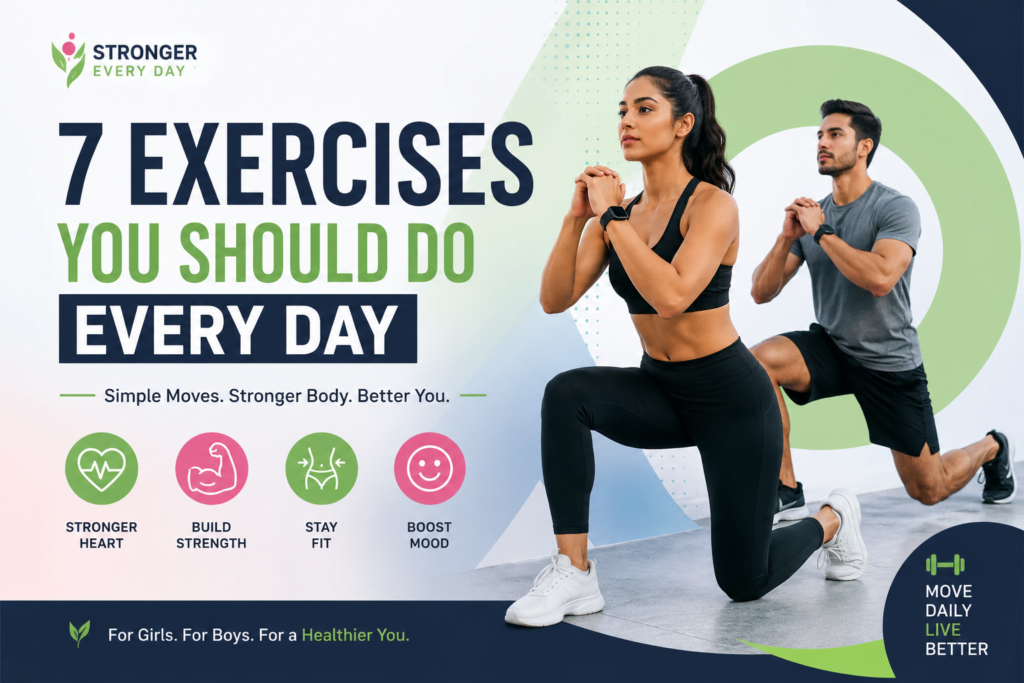
Regular exercise is one of the simplest ways to support a healthy and active lifestyle. You do not need an expensive gym membership or complicated equipment to become stronger, more flexible, and energetic. A simple daily routine using bodyweight exercises can help improve strength, balance, mobility, cardiovascular fitness, and overall well-being.
Whether you are a girl or a boy, the basic principles of exercise are largely the same. The best routine depends on your age, fitness level, goals, experience, and any physical limitations. Exercises such as squats, push-ups, planks, lunges, dead bugs, hip bridges, and supermans can be adapted to different fitness levels.
It is also important to remember that “every day” does not mean performing a hard workout every day. Your body needs recovery, especially after challenging strength workouts. You can alternate exercises, reduce intensity, or use some days for gentle mobility and walking.
Benefits of Daily Exercise
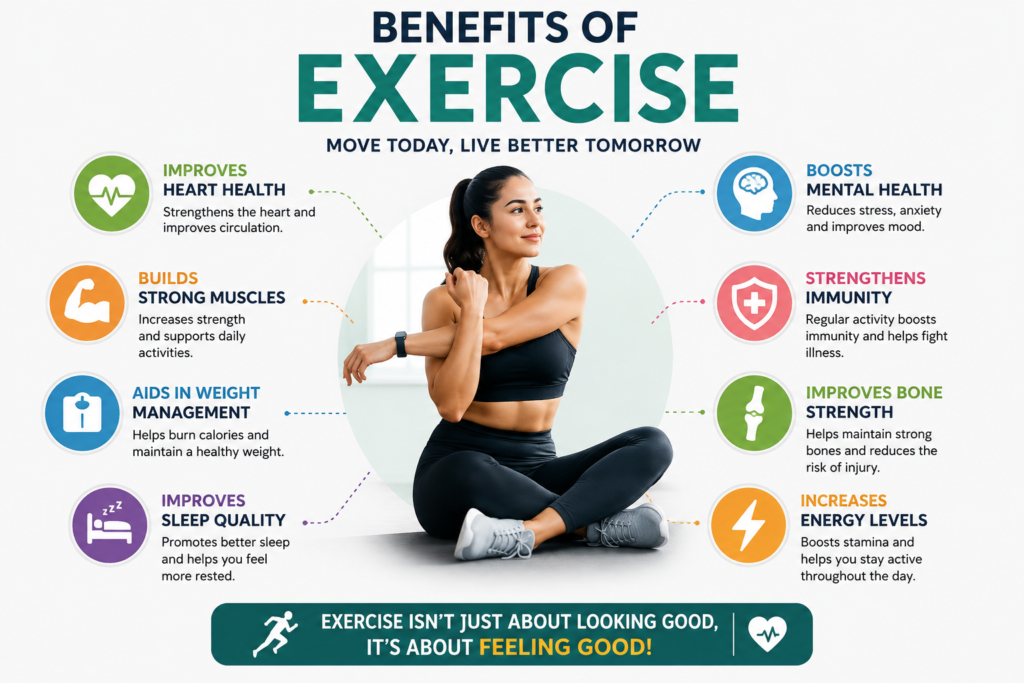
Daily physical activity can provide benefits for both physical and mental health. Regular movement can help strengthen muscles and bones, improve cardiovascular fitness, support healthy body composition, and increase functional fitness for everyday activities.
Exercise can also contribute to better mental well-being. Physical activity gives you an opportunity to take a break from studying, working, or spending long periods sitting. Even a short workout can help you feel more active and refreshed.
A consistent exercise habit is often more valuable than occasional intense workouts. Starting with manageable exercises and gradually increasing difficulty can make fitness easier to maintain over time.
How Exercise Improves Your Overall Health
Exercise affects many parts of the body. Strength exercises help muscles become stronger, while activities such as brisk walking, cycling, dancing, or jogging challenge the cardiovascular system.
Regular physical activity can also help maintain mobility and balance. Strong legs and hips can make activities such as climbing stairs, carrying objects, and walking easier. Core exercises can improve stability and body control.
A balanced exercise routine should include different types of movement rather than focusing only on one body part.
How Daily Exercise Boosts Your Mood
Physical activity is not only about physical fitness. Exercise can also support emotional well-being. Moving your body can provide a break from daily stress and give you a sense of accomplishment.
Activities such as walking, stretching, dancing, strength training, and sports can be enjoyable ways to stay active. Choosing exercises you enjoy can make it easier to build a long-term habit.
Exercise for Better Cardiovascular Health
Cardiovascular exercise makes your heart and lungs work harder. Walking quickly, jogging, cycling, swimming, dancing, and playing sports are common examples.
Bodyweight exercises can also raise your heart rate when performed as a circuit. Beginners should start slowly and increase activity gradually.
How Exercise Increases Energy Levels
Regular physical activity can help improve fitness and make everyday movement feel easier. If you spend most of your day sitting, even a short movement break can help you feel less inactive. Try taking a short walk, stretching, or performing a few bodyweight exercises during breaks.
Exercise and Better Sleep Quality
Regular physical activity is associated with better sleep for many people. Exercise can help establish a healthy daily routine and may make it easier to relax at night. Sleep should be treated as part of your fitness routine because the body uses rest and recovery to adapt to physical activity.
How Daily Exercise Supports Weight Management
Physical activity contributes to energy expenditure and can support healthy weight management when combined with appropriate nutrition. Exercise should not be viewed only as a way to lose weight. Strength, endurance, mobility, cardiovascular health, confidence, and overall well-being are also important goals.
Simple Exercises You Can Do at Home
One of the biggest advantages of bodyweight training is convenience. Many exercises require little or no equipment.
- Squats
- Push-ups
- Planks
- Lunges
- Dead bugs
- Hip bridges
- Supermans
Performing these exercises with proper technique is more important than rushing through a large number of repetitions.
Squats for Stronger Legs and Glutes
Squats work the major muscles of the lower body, including the quadriceps and glutes. They also require core control and balance. Stand with your feet approximately shoulder-width apart. Keep your chest comfortable and bend your knees and hips as you lower your body. Push through your feet to return to the starting position.
Push-Ups for Upper-Body Strength
Push-ups are an effective bodyweight exercise for the chest, shoulders, arms, and core. If standard push-ups are difficult, begin with wall push-ups or incline push-ups. As your strength improves, gradually progress toward floor push-ups.
Planks for a Stronger Core
Planks strengthen the core and encourage whole-body stability. Place your forearms or hands on the floor and extend your legs behind you. Keep your body in a controlled position without allowing your lower back to sag.
Lunges for Balance and Leg Strength
Lunges challenge the legs and glutes while also requiring balance and coordination. Step forward with one leg and lower your body under control. Push through the front foot to return to the starting position.
Dead Bugs for Core Stability
Dead bugs are a useful core-stability exercise. Lie on your back with your arms raised and knees bent. Slowly extend the opposite arm and leg while keeping your core controlled, then return to the starting position. The goal is controlled movement rather than speed.
Hip Bridges for Stronger Hips and Glutes
Hip bridges target the glutes and help develop hip strength. Lie on your back with your knees bent and feet placed on the floor. Press through your feet and lift your hips. Pause briefly before lowering them with control.
Supermans for Back and Core Strength
Supermans strengthen the muscles along the back while also challenging the core. Lie face down with your arms extended. Lift your arms and legs slightly from the floor while keeping the movement controlled. Lower them back down and repeat.
7 Exercises to Do Every Day for Girls
Girls can benefit from the same fundamental movements as boys. There is no need for a completely different set of exercises based solely on gender. The important factors are fitness level, goals, experience, and individual needs.
- 1. Squats – develop lower-body strength.
- 2. Push-Ups – train the chest, shoulders, arms, and core.
- 3. Planks – improve core stability.
- 4. Lunges – develop leg strength and balance.
- 5. Dead Bugs – build controlled core stability.
- 6. Hip Bridges – strengthen the glutes and hips.
- 7. Supermans – strengthen the back and core.
7 Exercises to Do Every Day for Boys
Boys can also use simple bodyweight exercises to develop strength, mobility, balance, and endurance. The routine should be adapted according to age and fitness level.
- 1. Squats – develop lower-body strength.
- 2. Push-Ups – strengthen the chest, shoulders, arms, and core.
- 3. Planks – improve core stability.
- 4. Lunges – strengthen the legs and challenge balance.
- 5. Dead Bugs – improve controlled core movement.
- 6. Hip Bridges – strengthen the glutes and hips.
- 7. Supermans – develop back and posterior-chain strength.
Upper Body Strength Exercises
Upper-body strength is useful for everyday activities such as carrying bags, lifting objects, pushing doors, and maintaining good physical function.
Push-Ups
Push-ups primarily train the chest, shoulders, and triceps while requiring core stability.
Incline Push-Ups
Incline push-ups are easier than traditional push-ups. Place your hands on a stable elevated surface and perform the movement with control.
Wall Push-Ups
Wall push-ups are a beginner-friendly option. Stand facing a wall, place your hands against it, bend your elbows to bring your body closer, and push back.
Plank Shoulder Taps
Start in a plank position and slowly lift one hand to touch the opposite shoulder. Alternate sides while trying to keep your hips stable.
Superman
Supermans strengthen the back and can complement exercises that focus on pushing movements.
Lower Body Strength Exercises
Strong legs and hips support walking, climbing stairs, running, jumping, and many everyday movements.
Squats
Squats are a fundamental lower-body exercise. They target the thighs and glutes and can be modified for different fitness levels.
Lunges
Lunges train each leg individually and challenge balance and coordination.
Hip Bridges
Hip bridges are useful for strengthening the glutes and hips.
Step-Ups
Step-ups can be performed using a stable step or low platform. Step onto the platform with one foot, bring the other foot up, and step down carefully.
Calf Raises
Stand upright and raise your heels from the floor. Lower them slowly. Calf raises can be performed while holding a stable surface for balance.
How to Build a Simple Daily Exercise Routine
A daily routine does not have to be complicated. Start with a few minutes of warm-up movement, followed by strength exercises and a cool-down.
- Warm-up: 5–10 minutes of walking, marching, arm circles, and gentle mobility.
- Squats – 10–15 repetitions
- Push-ups – 5–12 repetitions
- Lunges – 8–12 repetitions per leg
- Hip bridges – 10–15 repetitions
- Dead bugs – 6–10 repetitions per side
- Plank – 15–30 seconds
- Supermans – 8–12 repetitions
Beginners can start with one or two rounds. More experienced people may perform additional rounds depending on their goals and recovery.
Tips for Exercising Safely
Good technique should always come before speed or repetition count. Start with an appropriate warm-up and learn the basic movement pattern before increasing intensity. Stop if you experience sharp pain, dizziness, chest pain, or unusual shortness of breath.
If you are new to exercise, have an injury, or have a medical condition, consider speaking with a qualified healthcare or fitness professional before starting a new training program. Rest is also important.
Importance of Consistency Over Intensity
Many people start exercising with an extremely difficult routine and then stop because it becomes uncomfortable or difficult to maintain. A better approach is to build a realistic habit. Ten or fifteen minutes of consistent movement can be a useful starting point. As your fitness improves, you can gradually increase duration, repetitions, resistance, or difficulty.
Exercises for Different Fitness Levels
The same exercise can be modified to make it easier or harder. Beginners can perform wall push-ups before progressing to incline push-ups and eventually standard push-ups. Similarly, bodyweight squats can progress to more challenging squat variations as strength develops. Select a level that challenges you while allowing proper technique.
Combining Upper and Lower Body Exercises
A balanced routine should involve the entire body. Lower-body exercises such as squats and lunges develop leg and hip strength, while upper-body movements such as push-ups develop pushing strength. Core exercises such as planks and dead bugs help develop stability, while back-focused movements such as supermans complement exercises that train the front of the body.
Conclusion
Daily physical activity can be a simple and effective part of a healthy lifestyle. Exercises such as squats, push-ups, planks, lunges, dead bugs, hip bridges, and supermans require little or no equipment and can be adapted for beginners and experienced exercisers.
Girls and boys can both benefit from these exercises. Rather than choosing exercises based only on gender, focus on individual fitness level, goals, technique, and recovery.
Most importantly, exercise should be sustainable. Combine strength training with cardiovascular activity, mobility, adequate nutrition, hydration, and sufficient sleep. Start at a comfortable level, progress gradually, and give your body time to recover.
The best exercise routine is one that is safe, balanced, enjoyable, and realistic enough to maintain consistently.